Leadership: The Impact of the Full Human Being in Role
Summary: "Leadership: The Impact of the Full Human Being in Role" by John Bazalgette
Overview
This paper, produced by The Grubb Institute and presented at Belgirate 2 in November 2006, develops a theoretical and practical framework for understanding leadership as a deeply human, relational, and even spiritual endeavour. Rather than treating leadership as a set of competencies or positional authority, Bazalgette argues that genuine leadership emerges from a person's full engagement with their experience — emotional, psychological, contextual, and transcendent. The framework described, called the Transforming Experience Framework (TEF), offers a structured way for individuals to make meaning from their lived experience and translate it into purposeful action through role.
The Starting Point: Leadership as Symbiosis
The paper opens with a deceptively simple historical observation about Oliver Cromwell: "He was their leader: he followed them." This paradox frames Bazalgette's central argument — that leadership is not a one-directional exercise of authority but a dynamic, mutually constituted relationship between leader and follower. He draws on examples beyond the corporate world, pointing to parents and children, clinicians and patients, priests and congregations, and teachers and students as contexts where the most authentic leadership occurs. What these relationships share is an emotional depth and a willingness to be genuinely affected by the other — to encounter another as a full human being rather than as a functional unit within a hierarchy.
The paper identifies a fundamental tension in organisational life: that hierarchies tend to use power for control rather than liberation, keeping people from engaging with the full richness of their experience. The purpose of the Transforming Experience Framework is to provide an alternative — a mental structure that enables individuals to work more authentically and purposefully, regardless of their formal position.
Treasuring Experience: The Tavistock Tradition
Before introducing the framework itself, Bazalgette grounds it in the epistemological tradition of the Tavistock group relations conferences, which hold that lived experience in the here-and-now is not only studyable but is the richest resource available to human beings. Drawing on Henry James's description of experience as a spider's web catching every airborne particle, the paper makes the case that experience is volatile, multi-perspectival, and shaped by emotion, history, and context — but that, properly attended to, it reveals hidden truths.
Inspired in part by a Sanskrit verse affirming the completeness of the present moment, the paper argues that attending carefully to what is happening now — including one's own feelings, memories, and imagined futures — provides everything needed for authentic action. This is not a relativist claim; it takes full account of others' perspectives too, recognising that no individual holds the whole truth. Bion's concept of "O" — ultimate reality as it manifests through actual events — is also invoked to support this epistemological orientation.
The Transforming Experience Framework: Four Domains
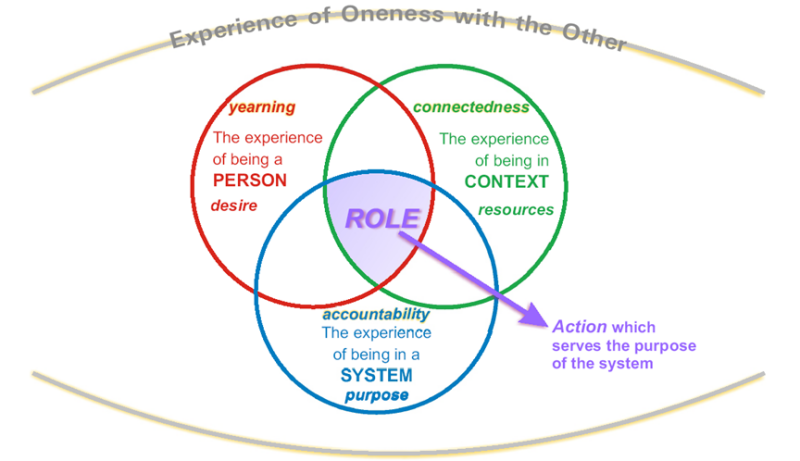
The core of the paper is the Transforming Experience Framework, developed over thirty years at the Grubb Institute. It proposes that human experience can be explored from four interconnected domains, represented as a Venn diagram in which each domain overlaps and dynamically influences the others. Together they enable a person to understand their experience and translate it into purposeful action through role.
Experience of Oneness with the Other
The first domain is the most expansive and explicitly spiritual. It concerns the experience of integration — of being connected to something larger than oneself. Bazalgette draws on quantum physics, theology, and the concept of the "holon" (the idea that each part reflects the essence of the whole) to argue that boundaries are better understood as semi-permeable membranes than as walls. This domain invites leaders to move from mechanistic, reductionist thinking toward systemic and integrative awareness.
This is the domain associated with what theorists of leadership "action logics" call the post-conventional level — characterised by what some label the "alchemist" or "shaman" orientation. Leaders like the Dalai Lama, Nelson Mandela, and Archbishop Tutu are cited as exemplars of those who draw on metaphysical frames of reference without losing practical relevance. The transcendent and the immanent coincide in ordinary moments of profound experience: a birth, a death, a beautiful sunset, or a phrase of music. The word "yearning" is used to capture the deep, pre-rational longing that connects human beings to one another and to something beyond themselves.
- Experience of Being a Person: The Locus of Desire
The second domain makes a crucial distinction between the concept of the "individual" — a separate, statistical unit — and the "person," understood as a nexus of relationships. A person carries within their inner world images of parents, siblings, colleagues, memories, hopes, and fears. They are a "being-in-a-relationship-of-communion," always in a condition of desire and in-needness — not merely in a libidinal sense, but biologically, socially, and spiritually.
This domain asserts that desire is a normal and generative feature of human life. The gaps we experience — for connection, recognition, meaning — are not deficiencies to be suppressed but sources of energy for action. Leaders who are aware of their own desires and yearnings, and who can hold them with some objectivity, are better placed to act from a position of wholeness rather than defensiveness. The ability to ask "why" — of oneself and of situations — is central to this domain, enabling motivations that have been hidden or unrecognised to be brought into awareness and mobilised.
- Experience of Being in Context: The Reservoir of Abundant Resources
The third domain concerns the relationship between the person and their wider context. Drawing on Bateson's ecological thinking and Lovelock's concept of the Earth as a living system, Bazalgette argues that context is not simply an environment to be managed or competed in, but a living, dynamic relational field from which resources flow — when we are open to receiving them.
A key move here is interpreting the Genesis allegory not as a moral tale of punishment, but as a warning against the kind of binary, "good versus evil" thinking that leads to defensive rather than creative engagement with context. The paper proposes three valuable understandings: that context is inherently good and contains the resources needed for survival and prosperity; that it has also become contaminated and therefore carries dangers; and that, with sufficient faith in its inherent goodness, it is possible to pierce through its threatening aspects and access what is truly available. Emery and Trist's work on environmental states is also invoked to show how an organism's engagement with its context varies according to the nature and turbulence of that environment.
- System: The Structure for Achieving Shared Purpose
The fourth domain focuses on the idea of the system — not as a tangible entity, but as a mental construct held in common by a group. A system is defined simply as human activities within a boundary that differentiates them from other systems. What gives a system coherence and direction is its purpose: the end it exists to serve, not merely for its own survival, but for the benefit of its wider context.
This domain introduces the concept of accountability — not just externally imposed, but internally held as a sense of duty to self, to others, and, for those with faith, to God. It is through the lens of system and purpose that personal desires can be focused and aligned with the desires of others, creating synergy rather than chaos.
Role: The Bridge Between Experience and Action
The concept of role is the framework's integrating mechanism. Role is defined not as a job title or fixed position, but as a dynamic process of finding, making, and taking one's place within a system in service of its purpose. Like a sailor adjusting continuously to wind and current while keeping the destination in mind, a person in role acts responsively and with intention.
The framework distinguishes between two aspects of role: the psychological role (how the person internally understands their purpose and expresses it in behaviour) and the sociological role (how others' expectations shape behaviour). Crucially, leadership in this framework is not restricted to senior positions. Anyone who acts with genuine accountability toward the purpose of their system — including a student or a child — is offering leadership.
Conclusion: The Full Human Being
The paper concludes by returning to its animating claim: that the most powerful leadership arises from the full engagement of a human being in role. The framework does not ask for detachment, tentativeness, or artificial professionalism. Instead, it enables leaders to be passionate, emotionally present, and genuinely purposeful — which in turn frees others to discover their own capacity for leadership and full humanity. Cromwell is revisited as an example of this kind of leadership across history: complex, loved and hated, but unmistakably engaged with the full weight of his humanity in role.
The Transforming Experience Framework ultimately offers a way to treat everyday working life as a source of meaning, not merely a site of performance — a persistent invitation to be more fully human in everything one does.